Wall treatments can change both the appearance and the acoustic character of a room. Traditional decorative panelling has long been used to add detail to interiors, while slatted acoustic panels have become another option for spaces where texture and sound control are both considerations. The two approaches can look equally deliberate, but they solve different design problems.
Homeowners comparing feature-wall options may come across products from Quietwalls when considering timber slats for contemporary rooms. These systems typically combine narrow slats with an absorptive backing, creating a linear surface that can contribute to acoustic control. Conventional wall panelling usually has a different purpose. Its main role is decorative, although the exact effect depends on its materials and construction.
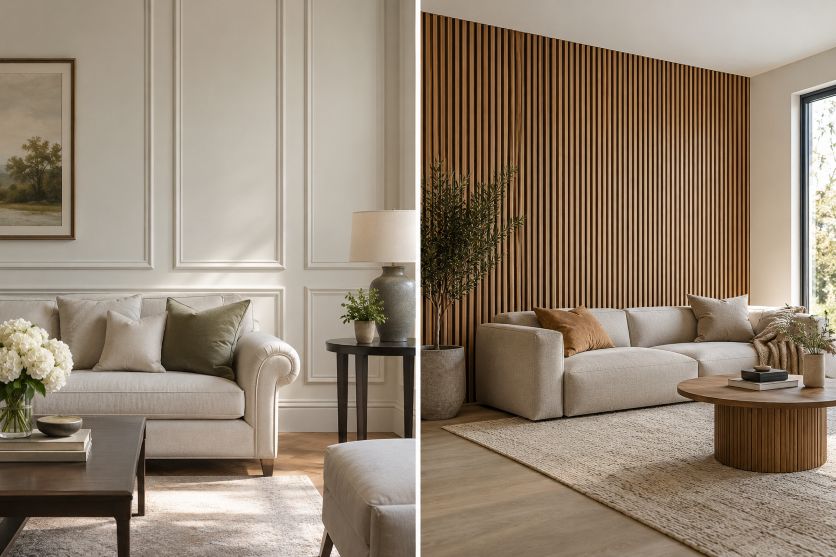
Traditional Detail or Contemporary Lines?
The clearest difference is visual. Traditional panelling creates patterns through mouldings, raised sections, recessed panels or framed sections. Styles such as wainscoting and shaker-inspired panels can bring structure to otherwise plain walls. They tend to work naturally with classic, transitional and heritage-inspired interiors.
Wood slats create a different rhythm. Repeated vertical or horizontal lines introduce depth without the ornament associated with mouldings. This makes them particularly compatible with contemporary and minimalist spaces. They can also bring warmth to rooms dominated by glass, plasterboard and other smooth finishes.
Real-world architecture shows how timber can serve both visual and practical purposes. WoodWorks, Wood Products Council documents the University of Pennsylvania’s New College House, where slatted wood wall panels were incorporated into a dining pavilion for acoustic control as well as aesthetic detailing.
What Changes When Texture Becomes the Focus?
Both approaches create texture, but they do so differently. Decorative panelling relies on changes in profile. Light and shadow form around mouldings, rails and recessed sections. Even when painted one colour, these details can give a wall greater architectural presence.
Slatted walls use repetition and spacing instead. The gaps between individual strips create narrow shadow lines. Wood grain can add another layer of visual variation. The result tends to feel more linear and less formal.
Neither effect is automatically better. A period-style sitting room may benefit from moulded panels that connect with existing doors, cornices and skirting. A modern home office or open-plan living area may call for simpler lines and natural materials.
Installation Is More Than a Question of Speed
Installation requirements vary considerably within both categories. Traditional moulding may involve measuring, cutting, levelling, fixing, filling and painting individual pieces. Pre-made decorative panels can reduce some of this work, but careful alignment remains important.
Slatted products are often supplied as larger panels or modular sections, which can simplify coverage of a broad wall. However, sockets, switches, corners and uneven surfaces still require accurate cutting and planning. The condition of the existing wall also matters.
Product construction affects installation as well. Armstrong World Industries, for example, notes that some acoustic wall products can be attached directly to structurally sound wall surfaces. This illustrates why installation instructions should be checked for the specific system rather than assuming all acoustic panels are fitted the same way.
Where Does Acoustic Performance Enter the Comparison?
This is where the difference can become more functional. Conventional decorative panelling should not automatically be treated as an acoustic solution. A hard panel may still reflect substantial sound into the room. Its performance depends on the complete assembly and the materials behind or around it.
The Acoustical Society of America explains that rooms containing many hard, reflective surfaces can become more reverberant. Absorptive wall and ceiling treatments can reduce reflections and reverberation, which can improve speech intelligibility.
Some slatted systems address this by combining the visible surface with sound-absorbing material behind it. The slats provide the decorative finish, while the backing helps absorb part of the sound energy reaching the wall. Acoustic performance still varies by product, installation method and wall assembly.
Published specifications illustrate that variation. Armstrong World Industries lists sound absorption ratings as high as 0.85 NRC for one type of wall-mounted blade system, depending on spacing. Its microperforated wood systems also use acoustic backing and optional insulation to improve absorption. These figures should not be applied to unrelated slatted products, but they demonstrate how construction influences performance.
Which Rooms Benefit Most From Each Approach?
Traditional panelling can make sense in dining rooms, hallways, bedrooms and formal living areas where architectural character is the main objective. It can frame furniture, reinforce proportions and connect newer finishes with older architectural details.
Acoustic slats may be more relevant in open-plan living rooms, media areas and home offices where reflective surfaces contribute to a lively acoustic environment. They can also work where the designer wants timber texture without introducing ornate detailing.
However, acoustic treatment should match the actual problem. Sound absorption within a room is different from sound isolation between rooms. WoodWorks notes that wall assemblies rely on specific combinations of materials and construction details for sound transmission performance. Adding or changing layers can affect how the overall assembly behaves.
Maintenance Depends on the Finish
Flat or moulded painted panels can generally be dusted and cleaned according to the paint manufacturer’s guidance. Damage may sometimes be repaired with filling, sanding and repainting, although matching an older finish can take care.
Slatted walls have more edges and gaps where dust can collect. Regular light dusting or careful vacuuming may therefore be useful. Material selection matters too, particularly when humidity, temperature and other environmental factors can affect interior finishes. Looking at interior materials suited to local conditions can provide useful context when considering how finishes may perform over time. Cleaning methods should also follow the panel manufacturer’s instructions, especially when timber veneers, felt backing or other specialist materials are involved.
Design Language Should Make the Final Decision
Traditional panelling and wood slats are better viewed as different tools rather than direct substitutes. Decorative mouldings can reinforce classic architecture and provide visual structure. Slatted acoustic treatments can offer a more contemporary appearance while adding sound absorption when they are designed and installed for that purpose.
The strongest choice starts with the room itself. Consider its architecture, existing finishes, maintenance needs and acoustic conditions before choosing a feature wall. When appearance and function are assessed together, the wall can feel integrated with the space rather than added simply as decoration.